SkyDiers
SkyDiers is an endless-fall action game for iPhone: jump from an aircraft at a great height, nosedive into an endless shaft and dodge through five biomes at up to 150 m/s, falling as far as you can before the tunnel wins.
- Role
- Designer and Developer
- Product
- Mobile Game, iPhone
- Location
- Personal project
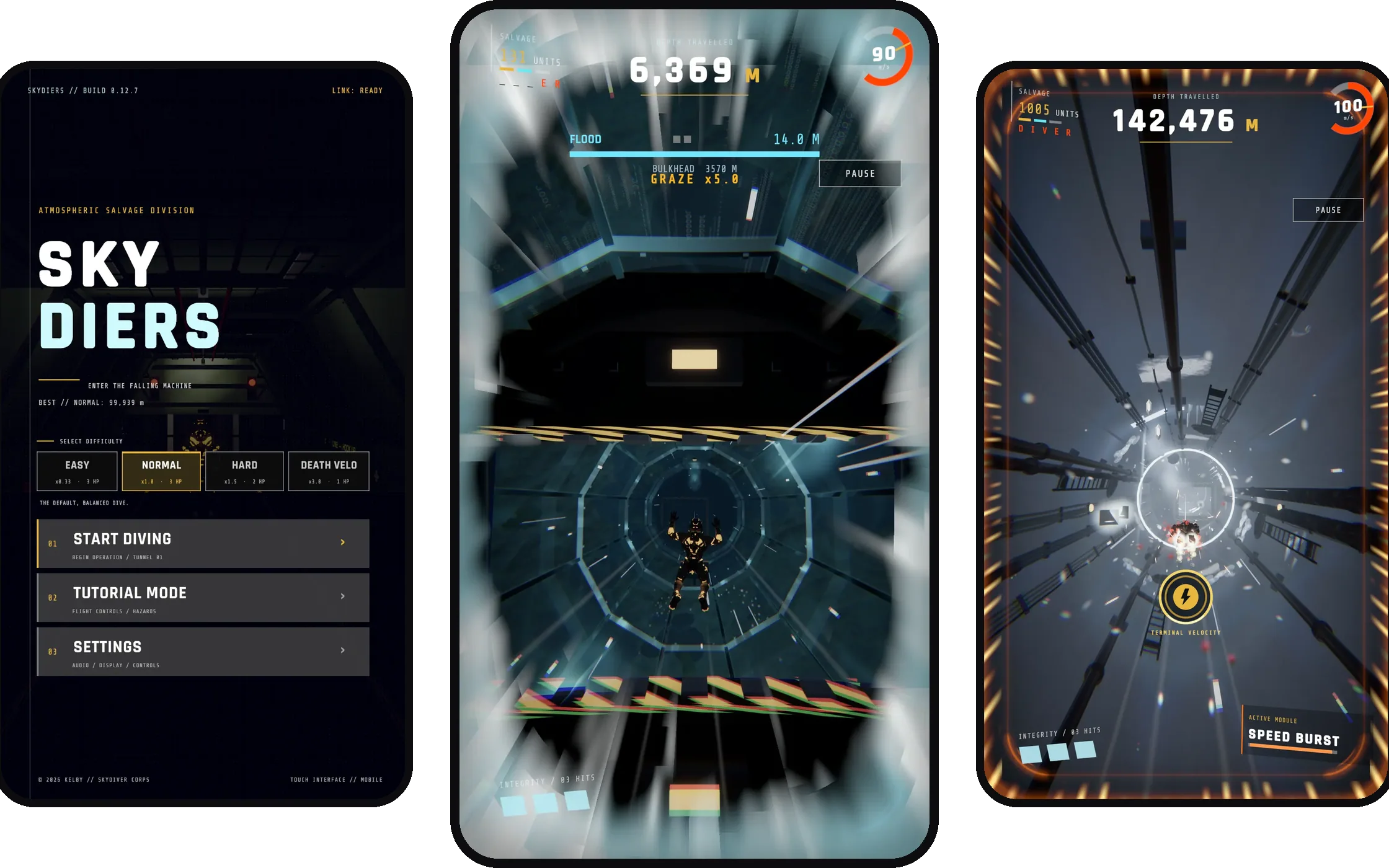
The Story
SkyDiers is an endless-fall action game for iPhone that I designed and built myself, with Claude as my coding partner and Unity 6 as the engine. You play an Atmospheric Salvage Division trooper who jumps from an aircraft at a great height, nosedives into an endless shaft and dodges through it at up to 150 m/s. The goal is simple: fall as far as you can before the tunnel wins.
I started it in July 2026 as a small MVP with one diver, one biome and three obstacles. Four months later it is a content-complete vertical slice running on my phone, with five biomes, a full menu-to-death loop and working rewarded ads. What's left before TestFlight is performance, testing and cleanup, not new features.
- C# scripts, about 43,400 lines of game code
- 207
- C# scripts, about 43,400 lines of game code
- biomes on a 50 km loop, each with its own music and hazards
- 5
- biomes on a 50 km loop, each with its own music and hazards
- obstacle types, plus 6 element jets
- 14
- obstacle types, plus 6 element jets
- control styles, chosen on first launch
- 5
- control styles, chosen on first launch
Role
Designer and developer
Type
Personal project, in development
Platform
iPhone first (iOS 15+, portrait)
Tools
Unity 6, URP, C#, Claude, Figma
Timeline
July 2026 to now
The game
Every run starts in the cargo bay of a plane flying high above the clouds. The ramp opens, the trooper walks out into a HALO jump and nosedives into the shaft below. From there it's a fall through a tunnel that builds itself as you go: you slide between nine lanes on a 3x3 grid to dodge pipes, crushers, lasers and turrets, while the speed keeps climbing.
One run
The full loop runs on device, from the menu to the death screen and back.
- 1Boots into the aircraft cargo bay menuShaders warm up during loading, so the menu runs smoothly
- 2HALO jump and nosedive into the shaft
- 3Dives through five biomes, dodging on a 3x3 grid
- 4Takes hits and loses limbs, healed by pickups
- 5Dies, and sees the Salvage Report
- 6Dives again, or watches an ad to continueRestarts skip the intro
What keeps you falling
Pickups and power-ups give every run something to chase.
- 1Collectibles in silver, gold and platinum heal and score
- 2Grazing obstacles builds a combo up to x5
- 3Five power-ups: Speed Burst, Ghost, Invincible, Slow-Mo and Magnetism
- 4Spelling D-I-V-E-R arms a 12-second ultimate150 m/s, smashes obstacles, pulls in pickups and sets off a sonic boom
Inside the game
Screens from the current build, grouped the way I organize them: the menus, the HALO jump, each biome, the destruction and set pieces, power-ups, the screens around a run, and the death sequence. Tap any screen to view it full size.
Designing the dive
At 150 m/s there's no time to read a menu or relearn a control. Most of my design work went into making a very fast fall feel fair, readable and quick to get back into.
1Let players choose how to steer
There's no single right way to steer a phone game. I built five control styles (Thumb Drag, Swipe, Zone Tap, Free Fall and Tilt) and a first-launch picker with a live 3D preview, so players try each one before their first jump. Thumb Drag is the default.
Trade-off: Five control styles to tune, test and keep fair, instead of one.
2Always leave a way through
Every obstacle spawn guarantees at least one safe cell on the grid, and difficulty ramps gradually from 600 m to 7,500 m. Deaths should feel like the player's mistake, never the generator's. Four difficulty modes, from Easy to Death Velo, set the pace.
Trade-off: The generator has more rules to follow, so it can't throw the most brutal layouts it's capable of.
3Damage you can see
Health is three blocks with a 2.5-second grace window after a hit. The diver can lose up to three limbs, and pickups heal them back, so the trooper's body shows how close the run is to ending without a glance at the HUD. A GORE toggle turns the ragdoll effects down.
Trade-off: A soft-body ragdoll system costs more to build and run than a simple health bar.
4Continue with a rewarded ad
Instead of interrupting play with forced ads, the only ad is a choice: after dying, players can watch one to continue the run. The full flow (consent, load, watch, reward and reload) works on device with Google AdMob.
Trade-off: Less ad revenue than forced ads in exchange for a fall that is never interrupted.
Five worlds in one shaft
The tunnel cycles through five biomes on a 50 km loop. Each has its own walls, atmosphere, music and two obstacles you only meet there, so a long run keeps changing.
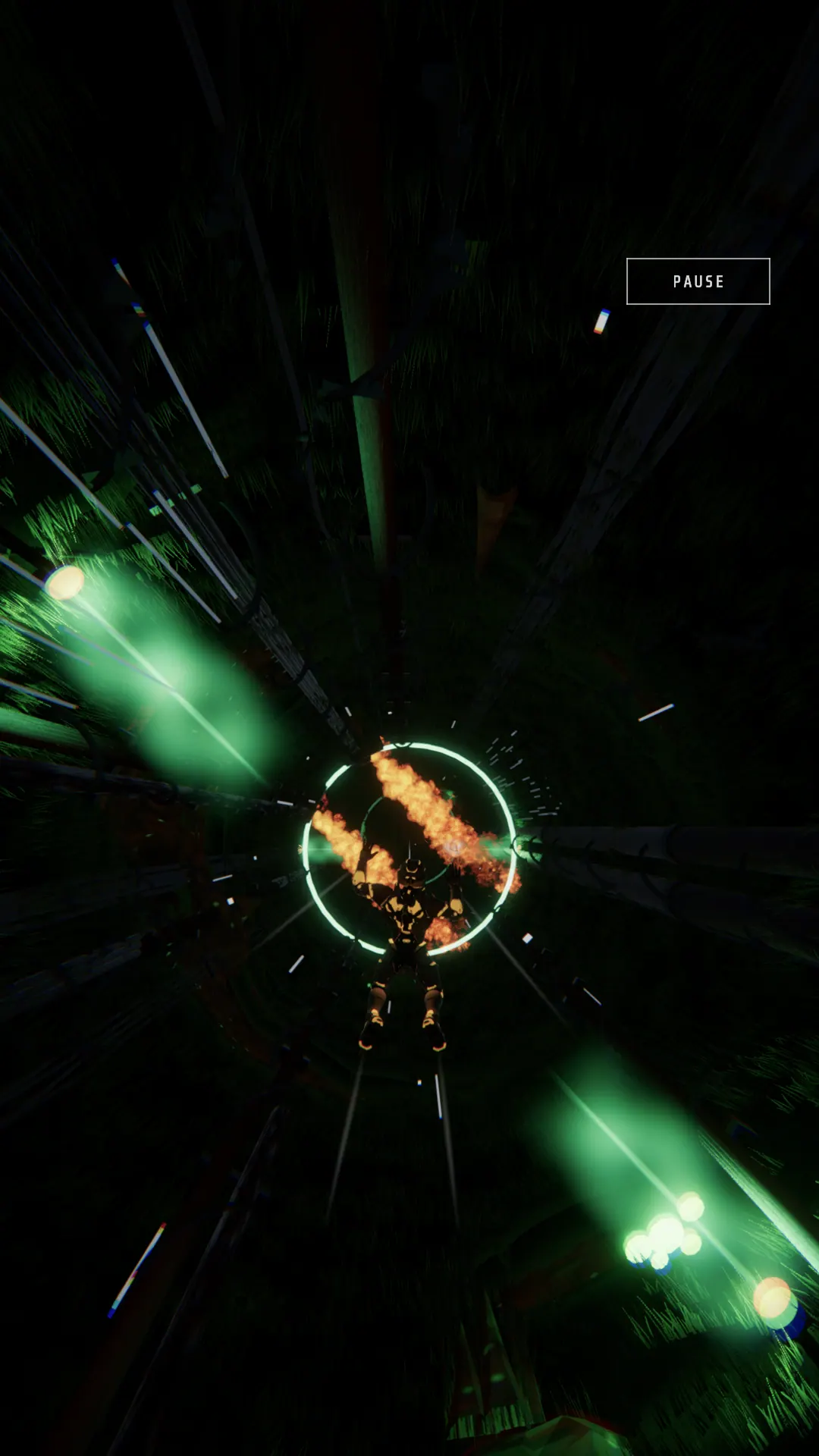
Cave
Decayed concrete blended into rock, magma breaches, stalactites and a red underground sky.
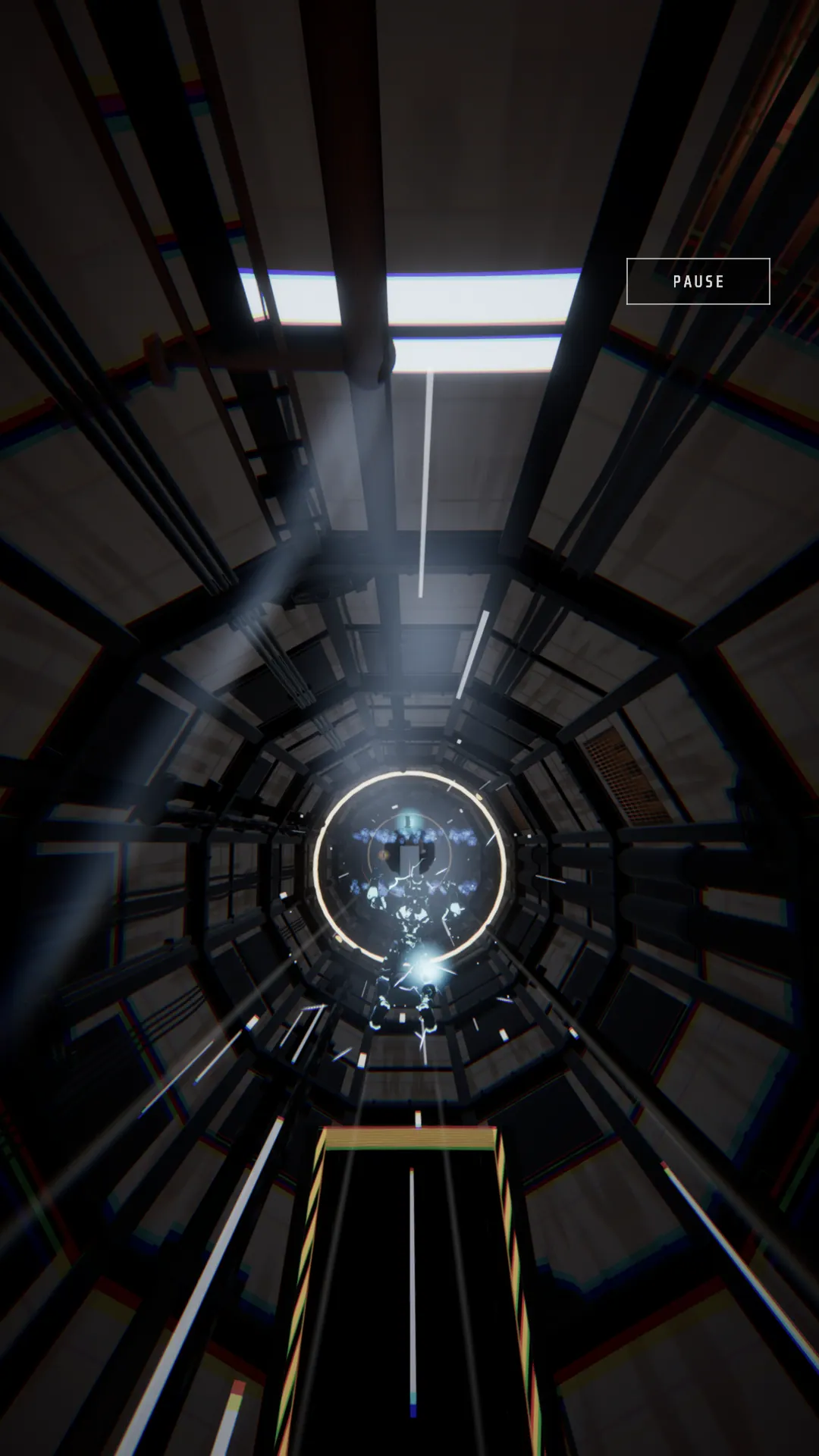
Industrial
Lanes of pipes and wires, steam vents and a walkway with NPC workers.
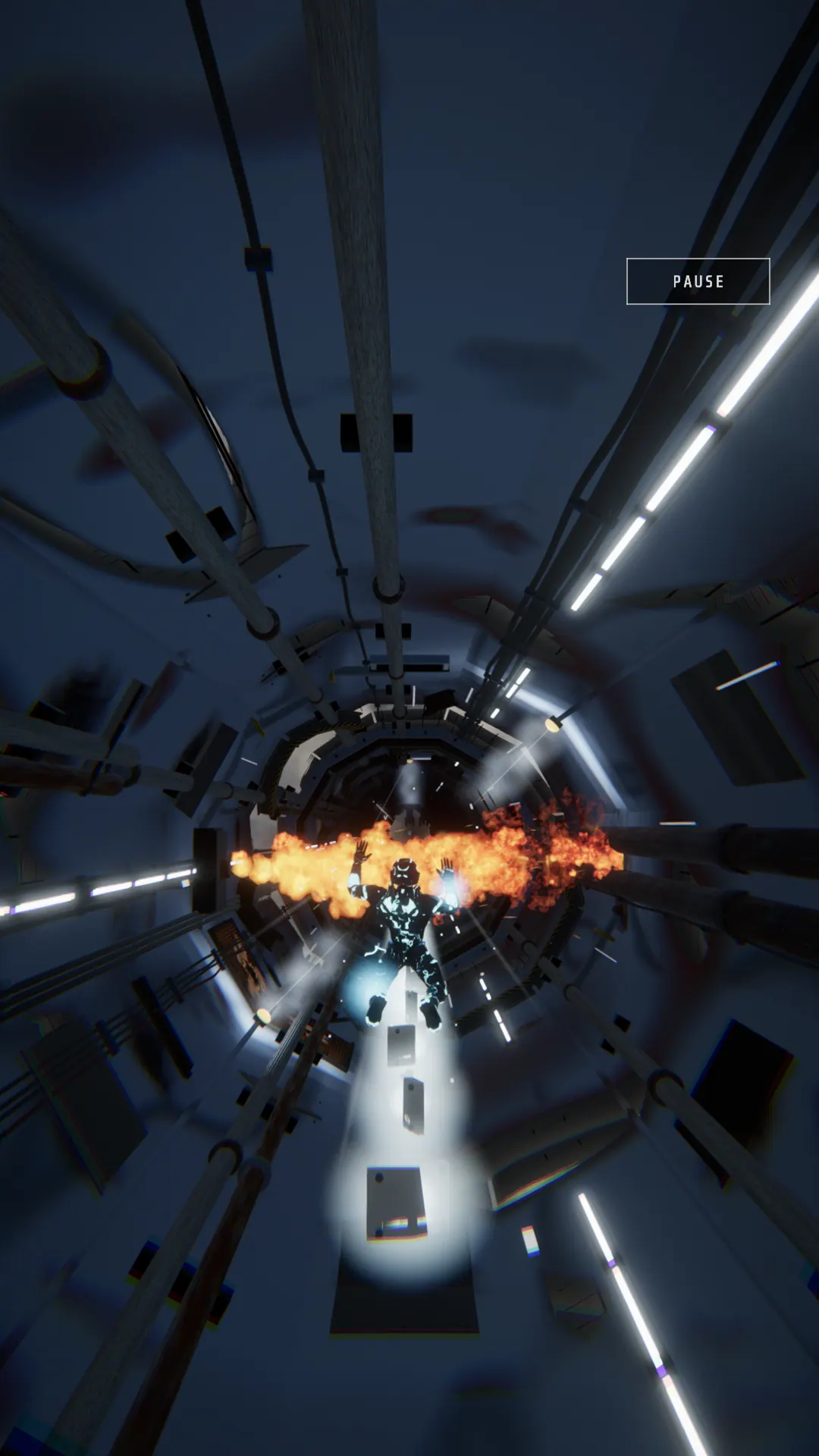
Military Bunker
A partly destroyed tunnel with deep holes in the walls and wreckage.
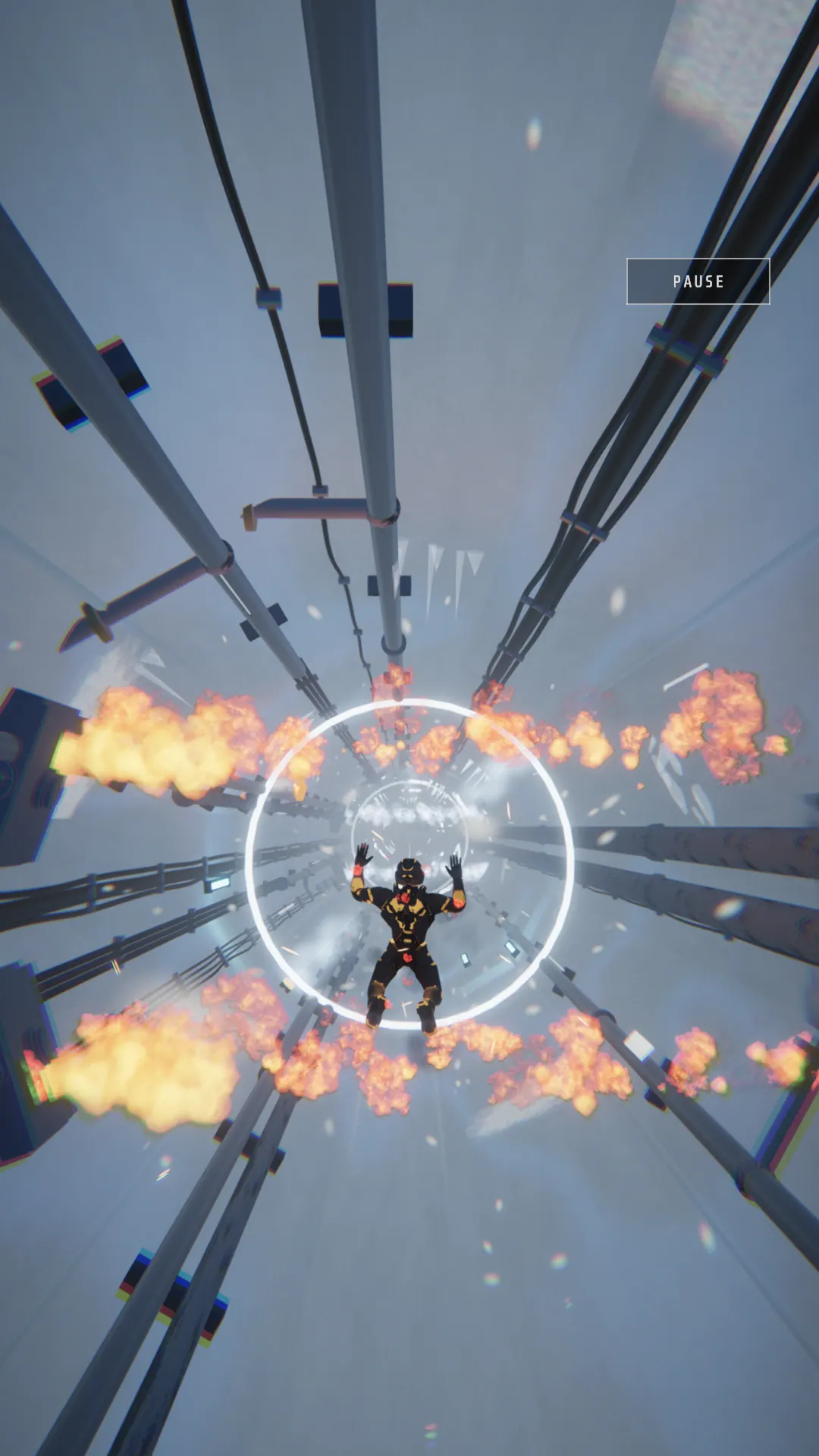
Deep Tech
A frozen cyan world of icicles, burst pipes and blizzard.
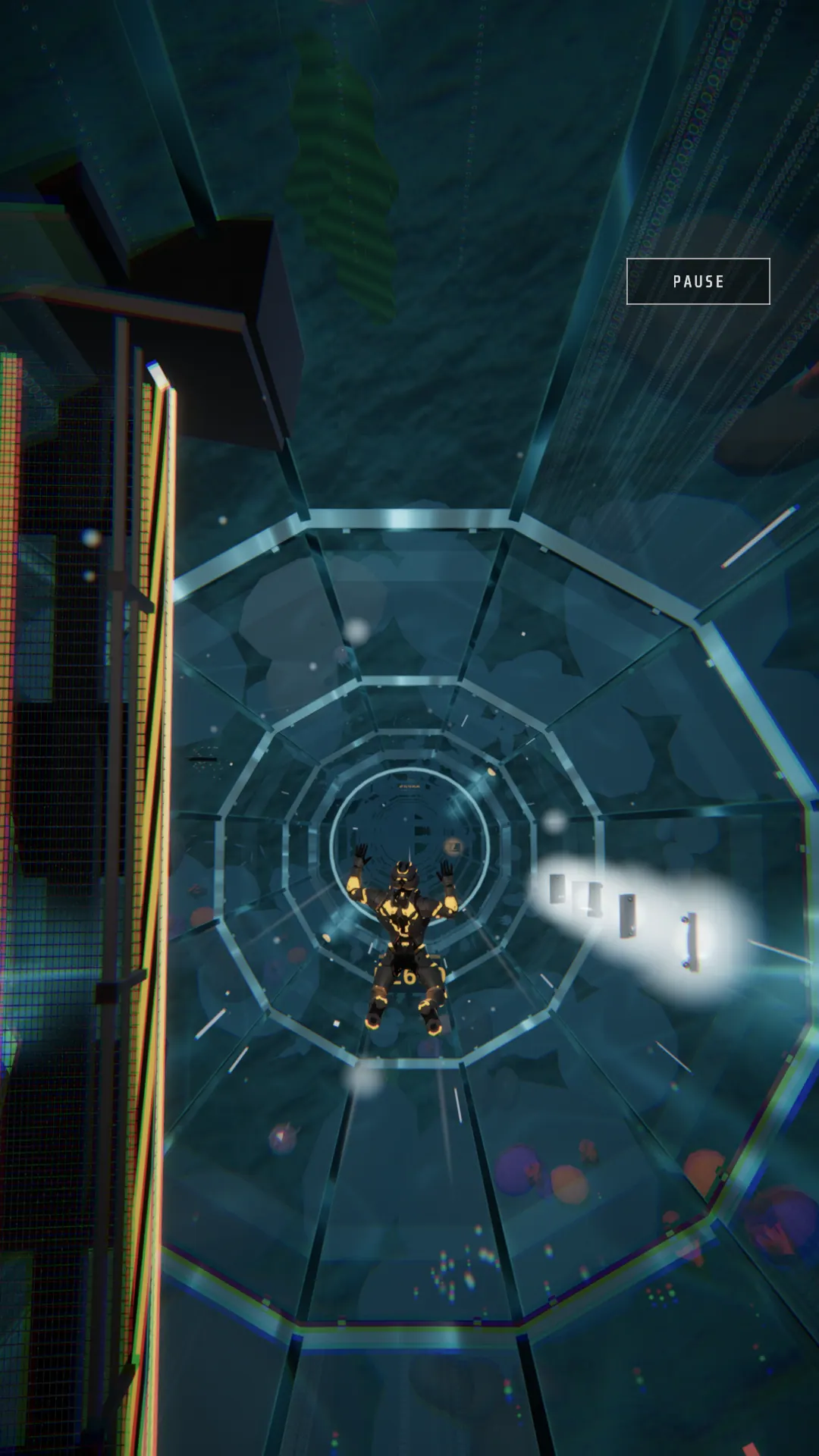
Ocean
An aquarium-glass tube with reefs and sea life, from 40 to 50 km.
Seven global obstacles (such as SwingArm, NeedleWall and SpinnerBar) appear everywhere, alongside biome hazards like the CrusherPress, LaserRows and SweepTurret. Fire, electric and ice jets burn, stun or chill the diver.
Set pieces break up the rhythm. Once per biome, the Tunnel Break tears the shaft open to the sky. In the Ocean Flood Chase, the hull fails and a 50 m/s wall of water chases the diver for about 35 seconds, until the run ends at closing blast doors. The chase has its own underwater camera filter, hull cracks and authored audio.
The presentation follows an aesthetic brief I wrote: grounded military-industrial sci-fi, with a presentation layer of mono type, amber accents, callsigns and cargo manifests. The menus, settings, pause screen and HUD were designed in Figma, and the HUD curves around a helmet visor that cracks as the diver takes damage.
Designing with Claude
I worked the way I do as a product designer, starting with a written design before building anything. I wrote a 21-section Game Design Document covering the concept, core loop, controls, biomes, obstacles, economy, power-ups, scoring, UI, performance and tuning values. I added separate documents for gameplay mechanics, the aesthetic brief, an MVP plan and a build prompt for Claude Code, plus a coded prototype of the collectible UI.
From there, Claude was my pair programmer. I set the direction (how the dive should feel, what each biome should look like, how hard a run should get) and Claude helped turn it into C# and Unity systems: the pooled endless tunnel, the obstacle spawner, controls, gore, audio, ads and the iOS build pipeline. We also built editor tools that generate biomes, kits and UI from menu commands, so changing the world didn't mean rebuilding it by hand.
The loop was short: describe a change, build to the phone, play it, read the device log and decide what's next. A dev-only panel lets me freeze the dive, switch any system on or off and jump to any biome, and SAVE LOG exports a full log from the phone. That turned playtesting into evidence instead of guesswork.
Making it run on a phone
A fast game has to stay smooth, so I treated frame rate as a design requirement. Expensive visuals are tied to graphics tiers: the detailed aquarium glass only renders on High, and the deep bunker wall holes only from Medium up. That took the Ocean from 35 to 57 fps and the Bunker from as low as 34 to 57 on an iPhone 17 Pro Max.
Device test on November 3, 2026. The Cave holds 60 fps for about 12 seconds and then drops, which points to the phone heating up rather than one expensive feature. A per-second trace of temperature, Low Power Mode, speed and light count is now in the device log to confirm it.
| Period | Frames per second | Change |
|---|---|---|
| Ocean | 57 fps | up from 35 |
| Military Bunker | 57 fps | up from 34–47 |
| Industrial | 56 fps | |
| Deep Tech | 48 fps | up from 45 |
| Cave | 34–39 fps | still the open problem |
- in the main menu, up from 2–22, by compiling 499 shader states during loading
- 58–60 fps
- in the main menu, up from 2–22, by compiling 499 shader states during loading
- to warm up those shaders on the loading screen
- 1.6 s
- to warm up those shaders on the loading screen
- expected game data, down from about 246 MB after the first size pass
- ~170 MB
- expected game data, down from about 246 MB after the first size pass
How it grew
The game went from a grey tunnel to a content-complete slice in about four months. Step through the recordings I made along the way, from the very first video to the current game.
1 of 7
Where it started
The first tunnel, filmed off my monitor
- A plain grey shaft and a placeholder capsule falling through it, running in the Unity editor
- Just enough to answer the first question: does falling down a tunnel feel fun?
What's next
The next milestone is an internal TestFlight for invited testers. Before the first upload, I'm re-measuring on a fresh build on both a new iPhone and an older iPhone 12-class phone, settling the Cave frame rate, and setting a performance floor of 55+ fps on High and 30+ fps sustained on an iPhone 12. Then it's crash reporting and a few analytics events, so tester feedback comes with data.
There are open design questions too. I'm choosing between four new collectible designs (Suit Plates, Stim Canisters, Nano-Cells and Fallen Diver Packs), and three rules from the design document still need answers, including a speed cap so the longest runs can't outrun the tunnel generator.